There are no items in your cart
Add More
Add More
| Item Details | Price | ||
|---|---|---|---|
Staring at complex math formulas can make the Quantitative Aptitude section feel like an impossible hurdle. If you are a non-engineer or someone who has always struggled with numbers, the ticking clock and unpredictable questions of the CAT exam can make you feel defeated before you even begin. This guide explains CAT 2026 preparation clearly and shows what to evaluate next.
The truth is that you do not need to be a math genius to score a top percentile. Success in CAT 2026 comes down to understanding the simple logic behind the numbers, rather than blindly memorizing hundreds of formulas. When you treat a math problem like a practical, everyday scenario, the anxiety fades.
By shifting your focus from rote learning to clear concepts, you will discover how to break down intimidating questions into easy, step-by-step puzzles. This approach helps you build a solid foundation, tackle advanced topics with confidence, and turn your biggest weakness into a strong scoring opportunity.
True CAT preparation is not about memorizing complex formulas. It is the process of breaking down quantitative problems into simple, logical steps. For non-engineers and students who feel anxious about math, the key is to shift away from rote learning and focus entirely on concept clarity. When you understand the basic logic behind a problem—like treating a time and work question as a simple daily task rather than a confusing equation—the math becomes intuitive. By choosing Rodha for your studies, you access a learning environment that deconstructs heavy concepts into easy, bite-sized pieces.
Deciding between coaching and self-study often comes down to how much guidance you need to build that logical foundation. While self-study works for some, a dedicated program provides a clear roadmap. A strong mentor helps you scale the difficulty gradually, moving from basic arithmetic to advanced algebra without overwhelming you.
To build a solid foundation, follow these steps:
Looking at the vast quantitative syllabus for the first time can make anyone feel overwhelmed, especially without an engineering background. Math anxiety usually hits when you open a mock test and see a wall of unpredictable questions mixed with a ticking clock. This fear is completely normal, and it often pushes students to search for CAT 2026 resources to find a quick fix. However, true preparation is not about rushing through chapters. It is about breaking down the logic behind the numbers.
You do not need to be a natural math genius to crack top MBA and IPMAT programs. The quantitative section feels intimidating because exams test your ability to think under pressure, not your ability to recall complex formulas. Think of a geometry problem not as a strict mathematical equation, but as a simple visual puzzle where you just need to find the missing piece. Once you understand the core logic, the anxiety fades, and solving these questions becomes a structured, step-by-step process.
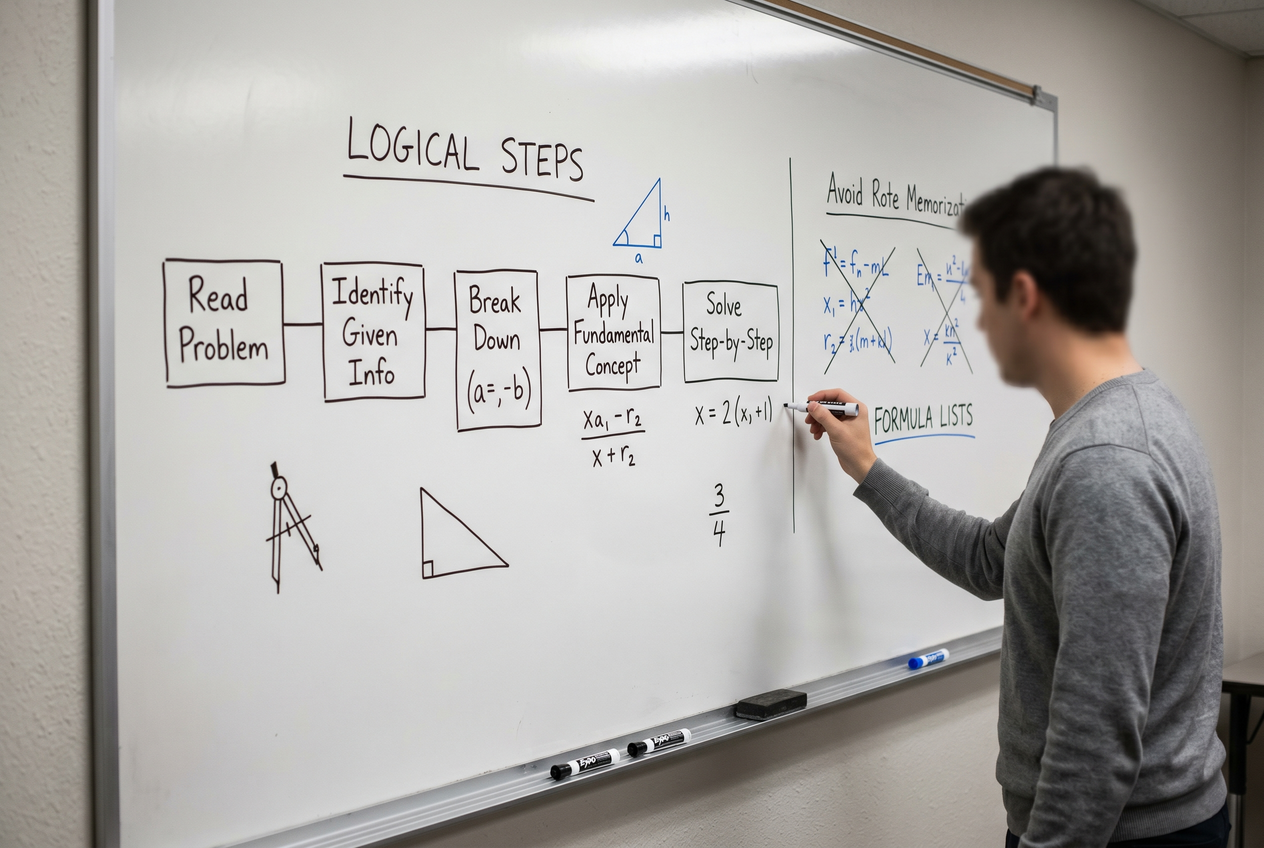
Memorizing formulas might feel like progress, but it often fails on exam day when questions are twisted. When you rely only on memory, a slight change in wording can leave you stuck. True CAT 2026 preparation requires a shift from asking what the formula is to understanding the logic behind the problem. Instead of recalling a complex equation for a time and work question, simply think about it like people painting a wall. This logic-first approach makes the Free Course for CAT 2026 highly effective for students who struggle with math.
Building your foundation on logical application helps you solve complex problems without panicking. When you understand why a concept works, your exam preparation becomes predictable. You start seeing patterns, allowing you to break them down into smaller steps.
| Approach | Short-Term Impact | Exam Day Reliability | Best For | Rote Memorization | Offers a quick start in early practice. | Breaks down when questions combine multiple concepts. | Basic school-level exams. | | Logical Application | Takes more time to learn initially. | Builds the confidence to tackle any surprise question. | High-pressure exams like CAT. |
Building a strong foundation begins with stripping away complexity and focusing on the core logic. When you start a new chapter like percentages, do not jump straight into advanced problems. Instead, begin with simple, everyday scenarios, such as calculating a discount at a grocery store. As you navigate the Rodha mock test dashboard for your studies, you will notice how a step-by-step approach keeps you from feeling overwhelmed. Once the core idea clicks, you can safely move on to guided practice with gradual difficulty scaling.
Transitioning from basic concepts to actual exam questions requires a clear strategy. Effective preparation focuses heavily on application rather than just theory. When you tackle higher-level questions, your goal is to identify the underlying logic rather than blindly applying a formula. If a question feels too dense, break the problem down into smaller steps to see where the trap lies. Finally, testing your skills in a reliable mock test series is crucial for spotting weak areas. Analyzing your common mistakes in these tests shows you exactly what to revise next.

A solid preparation strategy begins with knowing exactly where to spend your energy during the early months of 2026. If math makes you nervous, do not try to study everything at once. Instead, focus entirely on high-weightage areas like Arithmetic and Algebra before moving on to Numbers and Geometry. Think of Arithmetic as the foundation of a house. If you understand basic percentages, complex topics like profit and loss naturally make sense.
Dedicate your first three months purely to mastering these foundational concepts without worrying about the clock. A common trap for beginners is rushing to take a free mock test before understanding the core logic, which only damages confidence. Once your foundation is secure, spend the next two months practicing application-based questions and revising weak areas weekly.
Many students who struggle with math spend all their time trying to fix it, completely ignoring Verbal Ability (VA) and Reading Comprehension (RC). This is a dangerous trap because top management programs require you to clear sectional cutoffs. If you score brilliantly in Quantitative Aptitude (QA) but fail verbal, your effort goes to waste. Think of your exam score like a three-legged stool where QA, VA, and Logical Reasoning must all carry their own weight.
Creating a smart study plan means dividing your weekly hours based on your actual strengths rather than fear. Start by analyzing your current standing. You can easily test your baseline by solving previous year papers under timed conditions. This simple exercise reveals exactly how much time you need to allocate to QA versus VA. Once you know your starting point, you can adjust your daily routine to ensure no section gets left behind.
You do not need to be a math genius to score high in your entrance exams. Whether you are tackling the CAT math syllabus or preparing for IPMAT, the secret is to stop memorizing formulas and start understanding the underlying logic. Effective preparation is entirely possible when you break complex problems into simple scenarios. For example, treating profit and loss like a basic shopkeeper transaction makes the math feel familiar.
Finding the right guidance is crucial when figuring out how to prepare for quantitative aptitude without losing confidence. A logic-first methodology deconstructs intimidating concepts into intuitive steps. This structured approach helps serious aspirants build a solid foundation for 2026.
Non-engineers should begin their CAT 2026 preparation by focusing on foundational logic rather than advanced mathematics. Start with arithmetic and geometry, mastering the underlying concepts before moving to complex algebra. A structured approach that prioritizes conceptual clarity over speed during the initial months of study is highly recommended.
Yes. Scoring a 99 percentile in the CAT Quantitative Aptitude section relies on problem-solving logic, not rote memorization. By deconstructing complex problems into intuitive steps, you can solve advanced questions using basic principles. Bypassing formula dependency in favor of conceptual understanding is the key to top scores.
A logic-first approach eliminates math anxiety by replacing intimidating equations with easy-to-understand scenarios. It breaks down complex quantitative concepts into intuitive puzzles. Using gradual difficulty scaling in practice sets ensures students build confidence step-by-step before tackling advanced CAT level problems.
The transition requires a strong grasp of variables as logical placeholders rather than abstract symbols. Master percentages, ratios, and proportions first, as these form the bedrock of algebraic reasoning. Once you understand the logic behind arithmetic relationships, applying them to algebraic structures becomes a seamless progression.
Most students need three to five months of consistent practice to fully internalize a logic-first methodology. Initially, solving problems without formulas may feel slower. However, once the conceptual foundation is set, your accuracy and speed will naturally accelerate, giving you a distinct advantage on exam day.
No. Question selection is a critical skill for MBA aspirants. Attempting every question often leads to negative marking and wasted time. Focus on identifying and solving the questions that align with your conceptual strengths. A strategic, high-accuracy approach yields significantly better CAT percentiles than rushing through the entire section.
Gradual difficulty scaling prevents early burnout and builds sustainable confidence. By starting with fundamental problems and incrementally increasing the complexity, students naturally develop advanced analytical skills. This method ensures that when you face high-difficulty questions in the CAT or other MBA entrance exams, your logical framework remains intact and reliable.
Explore Rodha's YouTube Channel for more details and free strategy sessions to kickstart your CAT 2026 preparation.

Rodha Team